
What Is an AI Gateway? (And Why Your API Gateway Isn't Enough Anymore)
 Peter Hanssens
The Simple Definition
Your team is using ChatGPT. Your engineers are calling the Anthropic API. Someone in marketing connected Claude to Zapier. Three different departments have their own OpenAI keys, and nobody's quite sure what's being sent to which model.
Sound familiar? This is how most Australian companies look right now — not because they're being careless, but because AI adoption moved faster than the infrastructure to support it. An AI gateway is how you get back in front of it.
An AI gateway is a specialised middleware layer that sits between your applications (or users) and AI models. Every prompt, every API call, every response — it all flows through the gateway first.
Think of it this way: an API gateway is a bouncer checking IDs at the door. An AI gateway is a full security team that reads every conversation happening inside.
That means it speaks the language of tokens, not just bytes. It understands streaming responses, multi-step prompt chains, and the nuances of model-to-model routing. It can inspect the content of a prompt, not just its headers.
What It Actually Does
At its core, an AI gateway handles six things your existing infrastructure doesn't. The diagram below shows the full picture: application traffic flows in on the left, through the gateway's six control layers, and out to whichever LLM provider is most appropriate for that specific request.
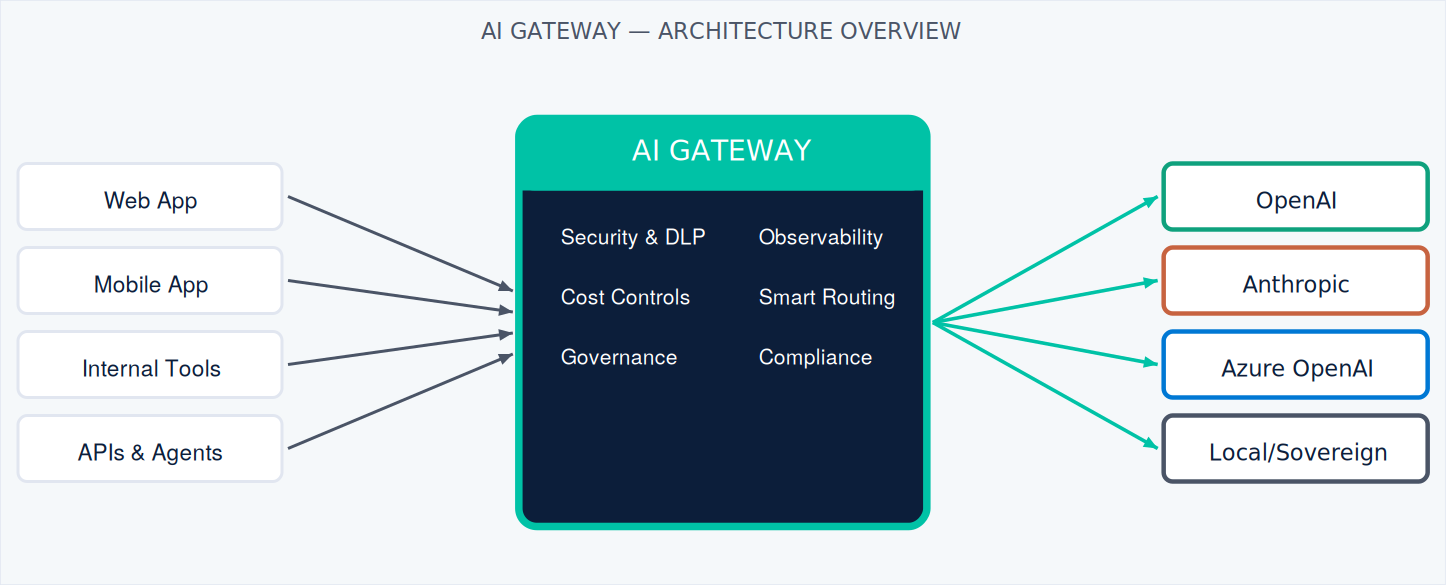
- Centralised Routing — one endpoint, multiple providers.
- Security and DLP — scan every prompt and response in real time.
- Cost Controls — track token usage by team and set budgets.
- Observability — log every interaction and monitor performance.
- Governance and Policy Enforcement — consistent rules from one place.
- Compliance and Auditing — tamper-resistant trails for every interaction.
Why Your API Gateway Isn't Enough
Traditional API gateways manage HTTP traffic between services brilliantly — but they were built for deterministic requests. Generative AI traffic is fundamentally different: content-sensitive, variable in size, streamed, non-deterministic, and token-priced. Your API gateway can't inspect prompt content, route based on token count, or detect when an employee accidentally pastes customer data into a prompt. An AI gateway can.
Who Needs One
You need an AI gateway as soon as more than one team is making direct calls to LLM providers; you've shipped an AI feature customers use; you operate in a regulated industry; or you're exploring agentic AI. For Australian companies, the Privacy Act, APRA guidance, and sector-specific regulations create real compliance exposure when AI usage is untracked and ungoverned.
Want to see what an AI gateway looks like for your stack?
Book a free 30-minute conversation.
RELATED_NODES
NODE_CHAIN // SIG_FAST
NODE_01
Static egress IPs for Postgres on Fly.io: an Envoy egress proxy
Jun 8, 2026 · 06m read
NODE_02
AI Observability in Action: Cost Measurement & Evals with Bifrost, Langfuse, and Drover
Jun 5, 2026 · 06m read
NODE_03
Self-Governing Codebases: Bridging the Code-Architecture Gap with Governed RLMs
Jun 4, 2026 · 06m read
Cloud Shuttle Insights