
From Black Box to Business Intelligence
When a CFO asks "what are we actually spending on AI?" — can you answer? When a board wants to know "how are we ensuring responsible use of AI?" — do you have a clear response? When a regulator asks for your AI interaction logs for the past 90 days — can you produce them without a fire drill?
Every LLM call generates data: what was asked, what model was used, how many tokens were consumed, how long it took, what was returned. Without a gateway, this data evaporates. With a gateway, every interaction becomes a structured record — automatically, from day one.
- Cost attribution at granular level — token usage broken down by user, team, product feature, or project.
- Performance visibility — latency metrics, error rates, model comparison data, and cache hit rates.
- Usage patterns and adoption tracking — which teams get the most value, which use cases generate best outputs.
- Anomaly detection — sudden spikes in token usage, unusual query patterns, or off-hours access.
What Real Governance Looks Like
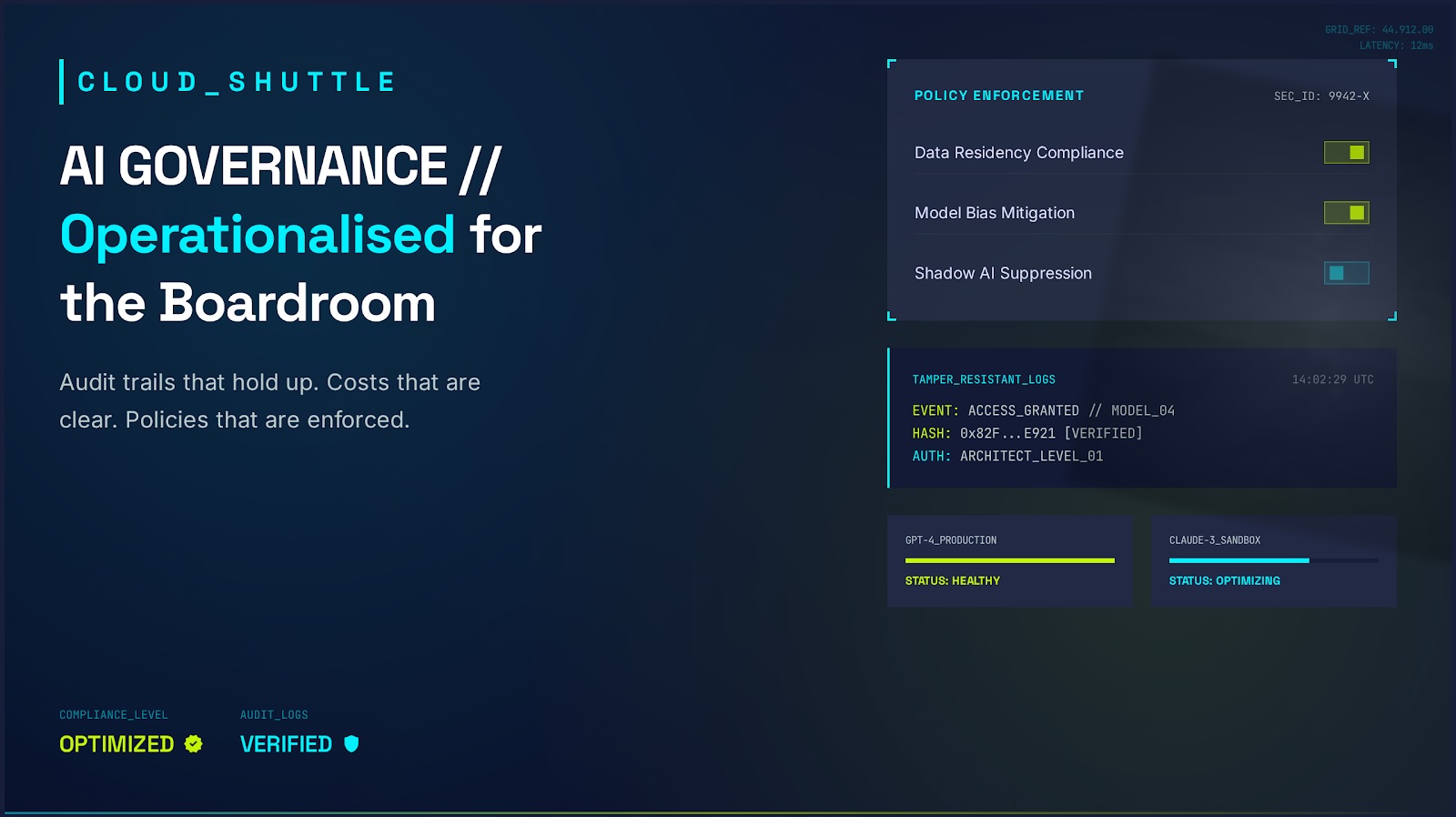
"AI governance" often gets reduced to a policy document nobody reads. A gateway operationalises governance — it moves the rules from a PDF into the infrastructure itself.
- Centralised policy enforcement — access controls, data handling rules, and rate limits configured once and enforced everywhere.
- Audit trails that hold up — tamper-resistant logs with timestamp, user identity, model, prompt hash, response, and any policy actions triggered.
- Model lifecycle governance — swap, deprecate, or restrict model access centrally without touching individual applications.
- Role-based oversight — different teams get different access, enforced at the gateway level.
Regulatory audits become a data export, not a multi-week investigation.
The Third-Order Payoff
- Faster AI adoption, systemically — governance built into infrastructure means teams don't wait for security reviews every time they ship a new AI feature.
- Stakeholder confidence — demonstrating governance (not just describing it) creates commercial advantage in sales cycles, procurement, and investor conversations.
- A culture of responsible AI — when governance is invisible and automatic, it stops being a burden and starts being a shared baseline.
Want to see what AI governance looks like for your regulatory context?
Contact Cloud Shuttle for a tailored conversation.
RELATED_NODES
NODE_CHAIN // SIG_FAST
NODE_01
Static egress IPs for Postgres on Fly.io: an Envoy egress proxy
Jun 8, 2026 · 06m read
NODE_02
AI Observability in Action: Cost Measurement & Evals with Bifrost, Langfuse, and Drover
Jun 5, 2026 · 06m read
NODE_03
Self-Governing Codebases: Bridging the Code-Architecture Gap with Governed RLMs
Jun 4, 2026 · 06m read
Cloud Shuttle Insights