

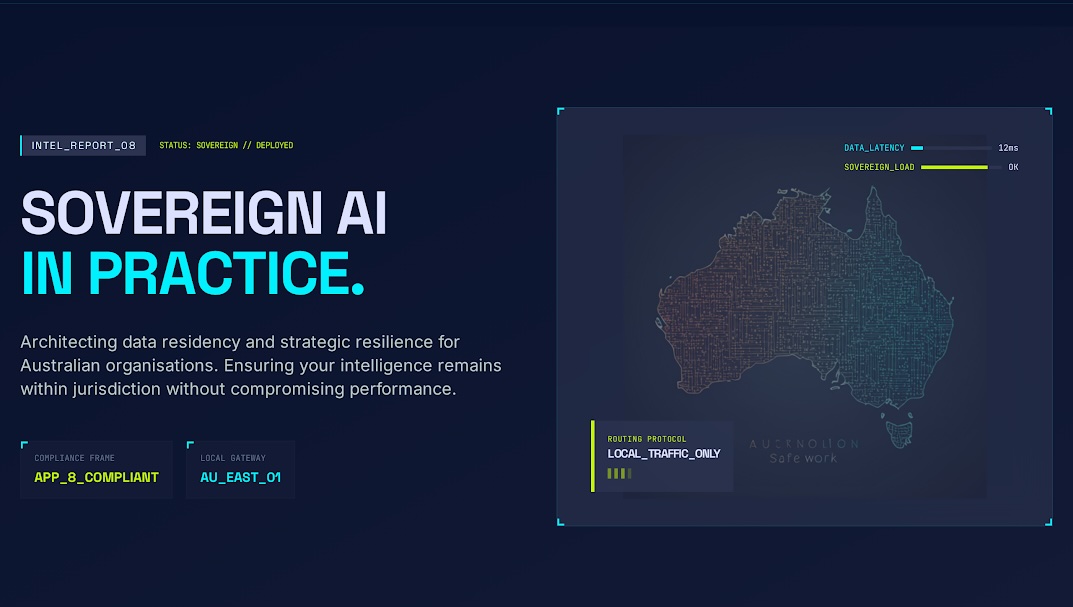
Every time your team sends a prompt to a US-based LLM provider, that data travels to a foreign jurisdiction. For some prompts, that's fine. For others — patient records, financial data, internal strategy, customer PII — it's a material risk.
Full autarky isn't realistic or necessary. What is achievable is strategic resilience: controlling the most sensitive workloads while using trusted international providers at scale.
The Australian Context
The Australian Privacy Act (APP 8) requires organisations to take reasonable steps to ensure overseas recipients handle personal information appropriately. Sending personal data to a foreign LLM provider without adequate safeguards is a potential breach.
- APRA-regulated entities face data localisation expectations under CPS 234 and increasing AI risk guidance.
- Defence and government contractors have explicit data sovereignty obligations.
- Healthcare providers handle data subject to strict cross-border transfer restrictions.
- Australia's emerging AI governance frameworks are expected to include transparency and record-keeping requirements.
How a Gateway Implements Sovereignty
- Data residency enforcement — routing rules ensure sensitive data types are only processed by models in approved jurisdictions.
- Model abstraction — your application sends to the gateway; the gateway routes based on data classification and sovereignty rules. Swap providers by changing config, not applications.
- Prompt-level data classification — not every prompt needs to be sovereign. The gateway classifies in real time and routes accordingly.
- Audit trails for cross-border disclosure — every request routed overseas is logged with the data classification that justified it.
The Strategic Upside
- Regulatory readiness — organisations with demonstrable sovereignty infrastructure will adapt to new AI regulation faster at lower cost.
- Customer and partner trust — "we keep your data in Australian jurisdiction" is increasingly a procurement differentiator.
- Reduced systemic risk — dependency on a small number of foreign AI providers creates concentration risk. A sovereign layer provides resilience.
Cloud Shuttle helps Australian organisations design AI infrastructure that meets performance and sovereignty requirements.
Let's talk about your specific context.
RELATED_NODES
NODE_CHAIN // SIG_FAST
NODE_01
Static egress IPs for Postgres on Fly.io: an Envoy egress proxy
Jun 8, 2026 · 06m read
NODE_02
AI Observability in Action: Cost Measurement & Evals with Bifrost, Langfuse, and Drover
Jun 5, 2026 · 06m read
NODE_03
Self-Governing Codebases: Bridging the Code-Architecture Gap with Governed RLMs
Jun 4, 2026 · 06m read
Cloud Shuttle Insights